

Keyword Research for Beginners: How to Find Keywords a New Blog Can Rank For
Keyword research is the foundation of every successful blog. Before you write a single word, you need to know what your audience is actually typing into Google — and which of those searches a new website can realistically rank for.
This step-by-step guide shows you how to do keyword research for a new blog using mostly free tools, and how to pick topics that bring traffic even when your site has little authority.
What Is Keyword Research?
Keyword research is the process of finding and analyzing the words and phrases people use in search engines, so you can create content that matches those searches. A “keyword” can be one word, but for bloggers it is usually a phrase or question, such as “how to clean a cast iron pan” or “best budget laptop for students”.
Why New Blogs Must Target the Right Keywords
A new site competing for “weight loss” or “make money online” will almost certainly lose to huge, established websites. But a new site can rank for specific, lower-competition searches — often called long-tail keywords. These searches have lower volume individually, but they are easier to win, add up quickly and often convert better because the searcher knows exactly what they want.
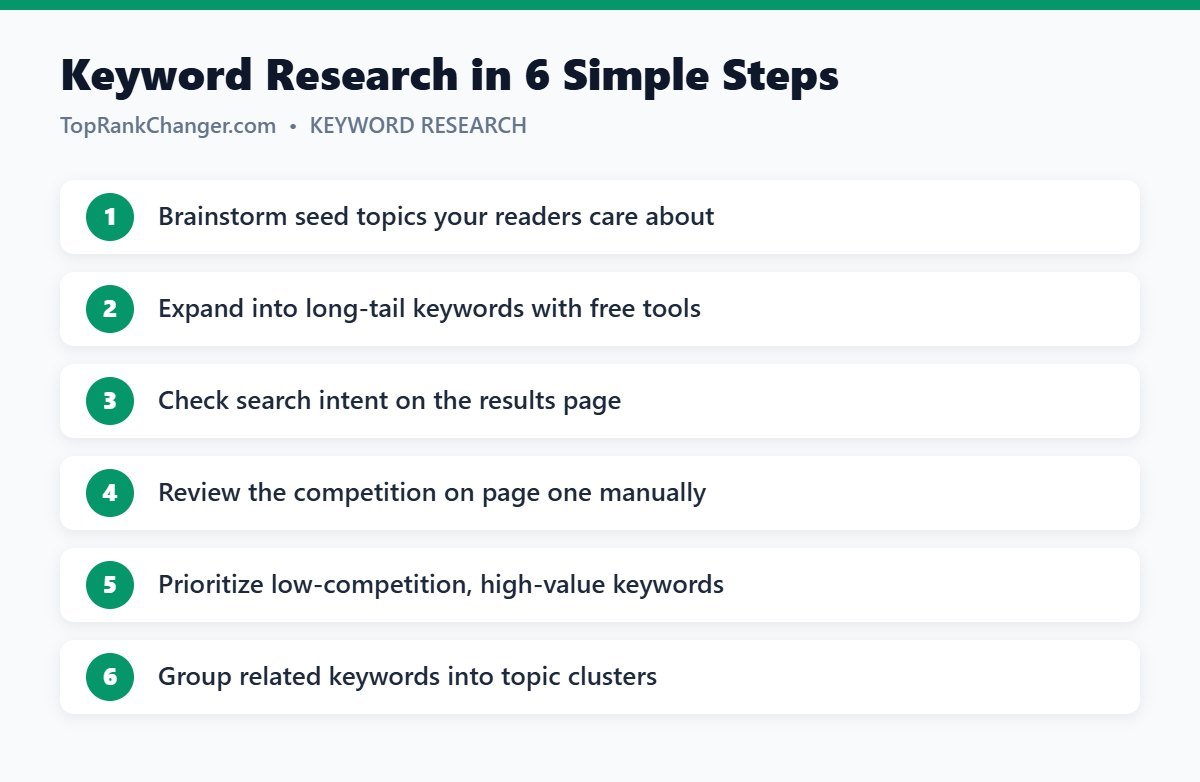
Step 1: Brainstorm Seed Topics
Start with broad “seed” topics related to your niche. If you run a home coffee blog, your seeds might be espresso, french press, coffee beans and grinders. Write down 10–20 seeds. Think about:
- Problems your readers have
- Products they use or want to buy
- Questions beginners in your niche ask
- Comparisons they might make (X vs. Y)
Step 2: Expand Seeds Into Long-Tail Keywords
Now turn each seed into specific search phrases. Free methods that work very well:
- Google Autocomplete – type your seed into Google and note the suggestions. Add letters (“french press a”, “french press b”) to get more.
- People Also Ask – the question boxes on the results page are real questions people search.
- Related searches – at the bottom of the results page.
- Google Search Console – once your site has some traffic, the Performance report shows queries you already appear for.
- Forums and communities – Reddit, Quora and niche forums reveal how real people phrase their problems.
Paid tools such as Ahrefs, Semrush or similar platforms speed this up and show estimated search volume and difficulty, but they are not required to get started.
Step 3: Understand Search Intent
For every keyword, ask: what does the searcher want to see? Search intent usually falls into four groups:
- Informational – they want to learn (“how to descale a coffee maker”).
- Commercial – they are researching before buying (“best burr grinder under $100”).
- Transactional – they are ready to buy (“buy baratza encore”).
- Navigational – they want a specific site (“starbucks menu”).
The easiest way to check intent is to search the keyword and look at the top results. If they are all step-by-step guides, write a guide. If they are all product lists, write a list. Learn more in our guide to search intent.
Step 4: Check the Competition Manually
Keyword difficulty scores are estimates. The most reliable test is to look at the actual first page of results. Signs a keyword is winnable for a new blog:
- Forum threads (Reddit, Quora) rank on page one.
- Small blogs or niche sites appear in the top results.
- Top results are outdated, thin or do not fully answer the question.
- Results only partly match the query — nobody has written the exact article yet.
If page one is filled with major brands, government sites and huge publishers that answer the question perfectly, save that keyword for later.
Step 5: Prioritize Your Keyword List
Put your keywords into a simple spreadsheet with columns for keyword, intent, estimated competition and business value. Then prioritize keywords that are:
- Closely related to your niche
- Low to medium competition
- Useful to your readers (and ideally to your monetization)
- Part of a bigger topic cluster you can build out
Step 6: Group Keywords Into Topic Clusters
Many keywords mean the same thing. “How to clean a french press” and “french press cleaning tips” should be one article, not two. Group similar keywords together, then organize articles into clusters: one broad “pillar” article supported by several detailed articles, all linked together. This helps Google see your site as an authority on the topic.
Step 7: Write for the Reader, Not the Keyword
Use your main keyword in the title, the URL and naturally in the introduction and a heading. After that, focus on answering the question completely. Google understands synonyms and related terms, so there is no need to repeat the exact phrase over and over.
Common Keyword Research Mistakes
- Chasing only high-volume keywords. A keyword with 200 searches a month that you can rank #1 for is worth more than one with 50,000 searches where you are on page five.
- Ignoring intent. Writing a guide when Google shows product pages rarely works.
- Creating duplicate articles for nearly identical keywords, which makes your own pages compete with each other.
- Trusting volume numbers blindly. Tool estimates can be off, and many long-tail keywords show “0” volume but still bring visitors.
Frequently Asked Questions
How many keywords should one article target?
One main keyword plus its close variations and related questions. A good article often ranks for dozens or hundreds of related searches.
Can I do keyword research without paid tools?
Yes. Google Autocomplete, People Also Ask, related searches, forums and Google Search Console are enough to build a strong keyword list for a new blog.
What is a good search volume for a new blog?
There is no fixed number. Focus on relevance and competition first. Many successful blogs are built on keywords with a few hundred monthly searches each.
Final Thoughts
Keyword research is not about finding magic words. It is about understanding your readers and picking battles you can win. Start with long-tail, low-competition topics, build clusters around them, and your blog’s authority — and traffic — will grow step by step.