Keyword Difficulty Explained: How to Judge If You Can Rank
Most keyword tools show a “difficulty” score next to each keyword. It is a useful shortcut, but it can also mislead beginners. Here is what keyword difficulty really means and how to judge it yourself.
What Is Keyword Difficulty?
Keyword difficulty (KD) is an estimate of how hard it would be to rank on the first page of Google for a keyword. Tools usually show it as a score from 0 to 100.
How Tools Calculate It
Each tool uses its own formula, which is why the same keyword can score 12 in one tool and 45 in another. Most formulas rely heavily on the number and strength of backlinks pointing to the pages currently ranking. Some also consider domain strength, search features and content signals.
Why Keyword Difficulty Scores Can Mislead
- They ignore content quality. A page with many links but a poor answer can be beaten.
- They ignore topical relevance. A site focused on your niche can outrank a big general site.
- They ignore intent match. Top results may only partly answer the question.
- They are estimates. Link data is never complete.
How to Judge Keyword Difficulty Yourself
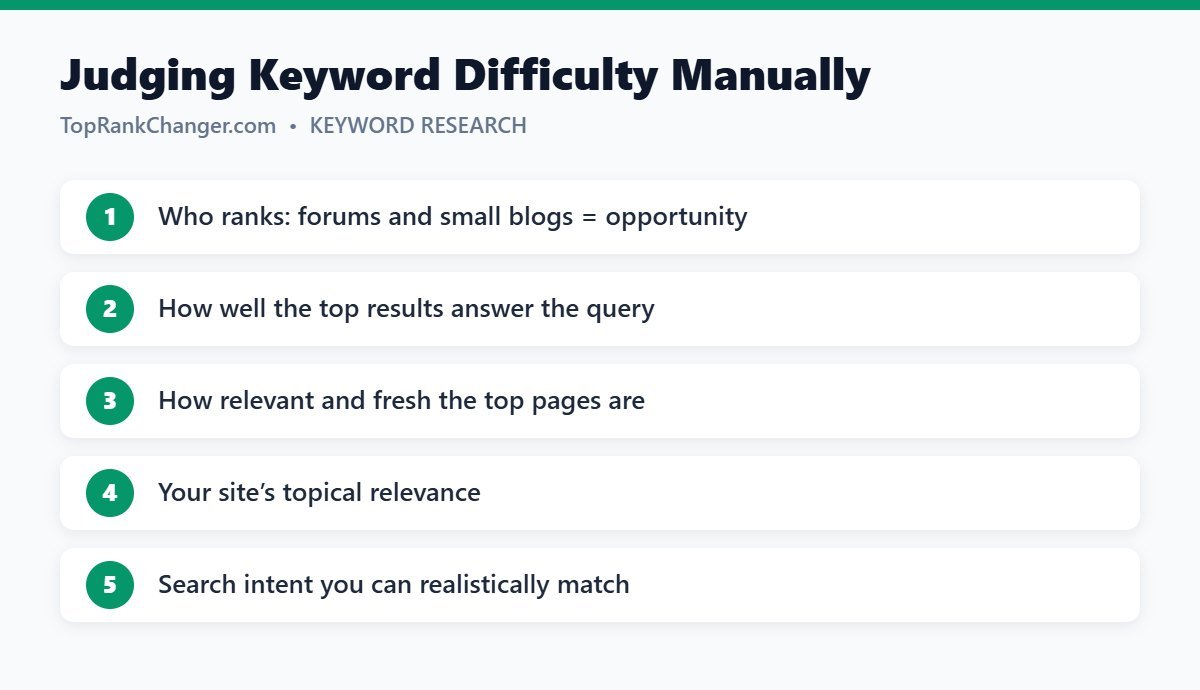
Search the keyword and study the first page. Ask these questions:
- Who ranks? If you see Reddit, Quora, forums or small blogs, there is an opening.
- How good are the answers? Outdated, thin or incomplete content is beatable.
- How exact are the matches? If no result targets the exact question, a focused article can win.
- What type of content ranks? Can you create that type (guide, list, tool, product page)?
- Is it dominated by brands? Pages full of household names and government sites are tough for new sites.
A Practical Rule for New Blogs
Start with keywords that have low tool difficulty and pass the manual test. As your site earns links and topical authority, gradually target harder keywords. Many successful blogs spend their first year almost entirely on low-difficulty, long-tail keywords.
Difficulty vs. Search Volume
High volume often means high difficulty. Don’t chase volume alone. A keyword with 300 monthly searches you can rank #1 for will bring more visitors than a 30,000-search keyword where you sit on page four.
Final Thoughts
Use keyword difficulty scores to filter ideas quickly, but make the final call by looking at real search results. The question is not “is this keyword hard?” but “can I create the best result for this search?” For the full process, see keyword research for beginners.