What Is E-E-A-T? How to Show Experience and Trust in Your Content
If you read about SEO for long, you will see the term E-E-A-T. It describes the qualities Google wants to reward in content. Understanding it will change how you write — for the better.
What Is E-E-A-T?
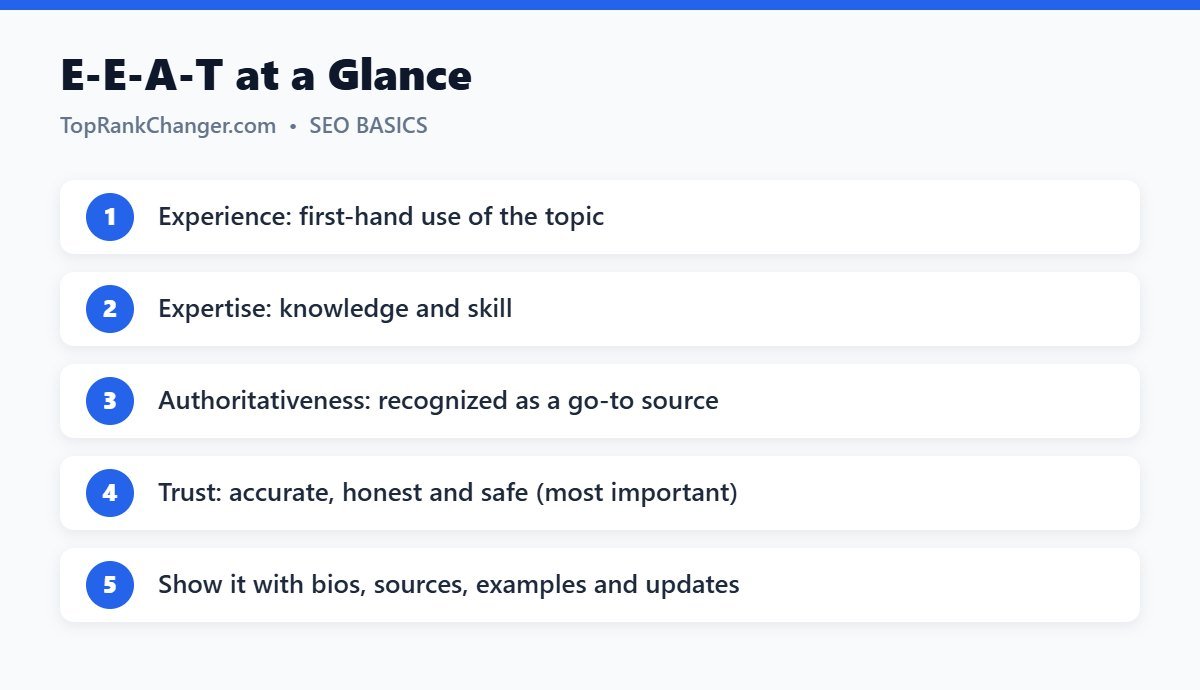
E-E-A-T stands for Experience, Expertise, Authoritativeness and Trustworthiness. It comes from Google’s Search Quality Rater Guidelines, a document used by human reviewers who evaluate search results. Their ratings don’t directly change rankings, but they help Google judge whether its algorithms are showing helpful, reliable content.
The Four Parts
Experience
Has the creator actually used the product, visited the place or done the task? A review written by someone who owns the camera is more useful than a summary of its specifications.
Expertise
Does the creator have the knowledge or skill needed? For some topics this means formal qualifications; for others, deep practical knowledge is enough.
Authoritativeness
Is the creator or website known as a go-to source on the topic? Mentions, links and references from other respected sources contribute to this.
Trustworthiness
Google describes trust as the most important member of the family. Is the content accurate, honest, transparent and safe? A page can’t have strong E-E-A-T if it isn’t trustworthy.
Is E-E-A-T a Ranking Factor?
Not a single, measurable factor. Instead, Google uses many signals that together help identify content showing these qualities. Think of E-E-A-T as a description of what great content looks like, not a checkbox.
YMYL Topics Need More
“Your Money or Your Life” topics — health, finance, legal and safety — can seriously affect people’s lives, so Google holds them to a higher standard of trust and expertise.
How to Show E-E-A-T on Your Blog
- Share real experience: include your own photos, screenshots, results, mistakes and lessons.
- Explain who is behind the site: a clear About page and author information build trust.
- Cite reliable sources: link to official documentation, research and original data.
- Keep content accurate and updated: review older posts and show the updated date.
- Be transparent: disclose affiliate links and advertising, and have a privacy policy and contact page.
- Stay focused: covering one subject deeply builds more authority than covering everything shallowly.
- Earn mentions: guest posts, interviews and quotes on respected sites grow your reputation.
What Hurts Trust
- Factual errors and outdated advice
- Exaggerated promises and clickbait
- Hidden affiliate relationships
- Aggressive ads or pop-ups that make the page hard to use
- No way to contact the site owner
Final Thoughts
E-E-A-T is really about being the kind of source you would trust yourself. Write from real experience, be accurate and transparent, and build your reputation over time. It is good for rankings because it is good for readers. For the basics of how ranking works, see what is SEO.