What Is SEO? A Complete Beginner’s Guide to Ranking on Google
If you have ever wondered why some websites show up at the top of Google while others are buried on page ten, the answer is almost always SEO. Search engine optimization sounds technical, but at its core it is simple: helping search engines understand your pages so they can show them to the right people.
This beginner’s guide explains what SEO is, how it works, why it matters, and the exact steps you can take today to start ranking — even with a brand-new website.
What Is SEO?
SEO (search engine optimization) is the practice of improving a website so that it appears higher in unpaid (“organic”) search results on Google, Bing and other search engines. The higher and more often your pages appear for relevant searches, the more visitors you get — without paying for each click.
Think of Google as a librarian with billions of books. When someone asks a question, the librarian tries to hand over the single most useful book. SEO is everything you do to make sure your “book” is well organized, clearly labeled, trustworthy and genuinely the best answer.
Why SEO Matters
- It brings consistent, free traffic. A page that ranks well can bring visitors every day for years, long after you publish it.
- Searchers have intent. People who search are actively looking for something, so they are more likely to read, subscribe or buy.
- It builds trust. Many users see top-ranking sites as more credible.
- It compounds. Each good article adds to your site’s overall authority, making future articles easier to rank.
For bloggers in particular, organic search is usually the largest and most stable traffic source. Social media traffic spikes and disappears; search traffic keeps coming as long as your content stays helpful.
How SEO Works: The Short Version
Search engines follow three basic steps:
- Crawling – automated programs called crawlers (Google’s is Googlebot) discover pages by following links and reading sitemaps.
- Indexing – Google analyzes each page’s content and stores it in a huge database called the index.
- Ranking – when someone searches, Google’s algorithms sort through the index and order results by how relevant and useful they are.
If a page cannot be crawled, it cannot be indexed. If it is not indexed, it cannot rank. That is why SEO starts with the technical basics before moving on to content and links. We explain this process in more depth in How Google Search Works.
The Four Pillars of SEO
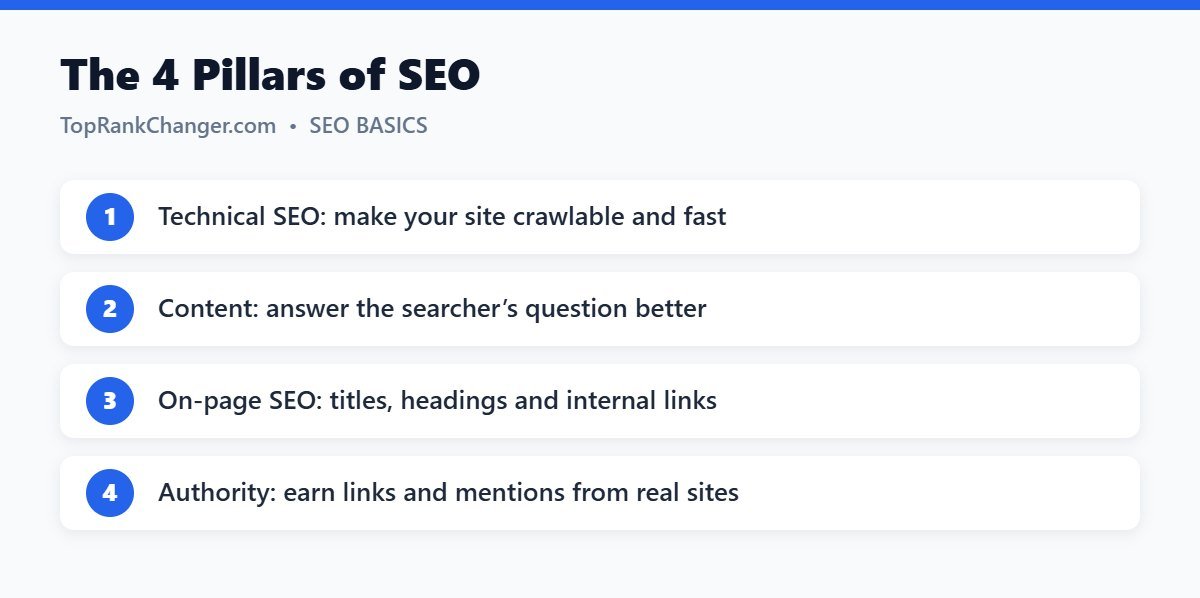
1. Technical SEO
Technical SEO makes sure search engines can access, crawl and understand your website. It covers site speed, mobile-friendliness, HTTPS security, XML sitemaps, clean URL structures and fixing crawl errors. A slow or broken site frustrates both users and crawlers.
2. Content
Content is the reason people search in the first place. Google rewards content that is helpful, accurate and written for people rather than for algorithms. The best content fully answers the searcher’s question, shows real experience with the topic and is easy to read.
3. On-Page SEO
On-page SEO is how you optimize individual pages: writing clear title tags, using descriptive headings, including your main topic naturally, adding helpful images with alt text and linking to related articles on your site. Our on-page SEO checklist walks through every element.
4. Authority (Off-Page SEO)
Authority comes largely from other websites linking to yours. Each relevant, natural link acts like a vote of confidence. Mentions, reviews and a strong brand also help show that real people trust your site.
What Google Looks For: Helpful, Trustworthy Content
Google has said repeatedly that its systems are designed to reward content created primarily for people. Its quality guidelines use the concept of E-E-A-T:
- Experience – does the author have first-hand experience with the topic?
- Expertise – does the content show knowledge and skill?
- Authoritativeness – is the site or author a recognized source on the subject?
- Trustworthiness – is the information accurate, honest and safe? Trust is the most important of the four.
E-E-A-T is not a single ranking factor you can switch on. It is a way of describing the qualities that make content reliable. Showing who wrote a page, citing sources, keeping information up to date and sharing real examples all help.
SEO vs. Paid Search (PPC)
Paid search ads appear at the top of results and are labeled “Sponsored”. You pay every time someone clicks. Traffic stops the moment you stop paying. SEO takes longer to produce results but traffic continues without a per-click cost. Most successful websites treat SEO as their long-term foundation.
How Long Does SEO Take?
For a new website, it commonly takes several months before articles start ranking for meaningful searches, and six to twelve months to see steady growth. The timeline depends on competition, how often you publish, the quality of your content and how many sites link to you. Choosing less competitive topics at the beginning helps you get results faster.
Getting Started: 7 Steps for Beginners
- Set up Google Search Console. It is free and shows which searches bring people to your site, plus any indexing problems.
- Install an SEO plugin if you use WordPress (such as Yoast SEO or Rank Math) to manage titles, meta descriptions and sitemaps.
- Research keywords before writing. Look for specific questions your audience asks. Read our guide on keyword research for beginners.
- Write the most helpful answer you can. Cover the topic completely, use examples and keep it easy to scan.
- Optimize each page with a clear title, descriptive headings and internal links.
- Make your site fast and mobile-friendly. Use a lightweight theme and compress images.
- Be patient and consistent. Publish regularly, update older posts and track your progress in Search Console.
Common SEO Myths
- “You need to repeat your keyword many times.” Keyword stuffing hurts readability and can hurt rankings. Use your topic naturally.
- “Longer content always ranks better.” Length only helps when it adds value. Answer the question fully, then stop.
- “SEO is a one-time task.” Search results change constantly. Good SEO is ongoing maintenance.
- “You can buy your way to the top.” Buying links violates Google’s spam policies and can lead to penalties.
Frequently Asked Questions
Can I do SEO myself?
Yes. Most of the fundamentals — keyword research, writing helpful content, on-page optimization and basic technical fixes — can be learned and done by a beginner using free tools.
Is SEO free?
Organic traffic is free, but SEO takes time and sometimes money for tools, hosting or content. Many excellent tools, like Google Search Console, cost nothing.
What is the most important SEO factor?
There is no single factor, but consistently helpful content that matches what searchers want is the foundation everything else is built on.
Final Thoughts
SEO is not a trick — it is the process of making your website the best, clearest answer for the people searching. Start with the basics, focus on helping your readers, and improve a little every week. The results build on each other over time.